Your numbers
You released it. Now see what it actually did.
Most artists find out how a release went by refreshing a streaming dashboard and guessing at the rest. Audora puts the answer on your home screen: how many plays, how many people saved it, which stores they used, which playlists carried it, and whether they went looking for your song or were played it by an algorithm. It comes from the distributor's own reporting — the same source the labels read.
 Reading the week · 09:40
 Week two · 08:12
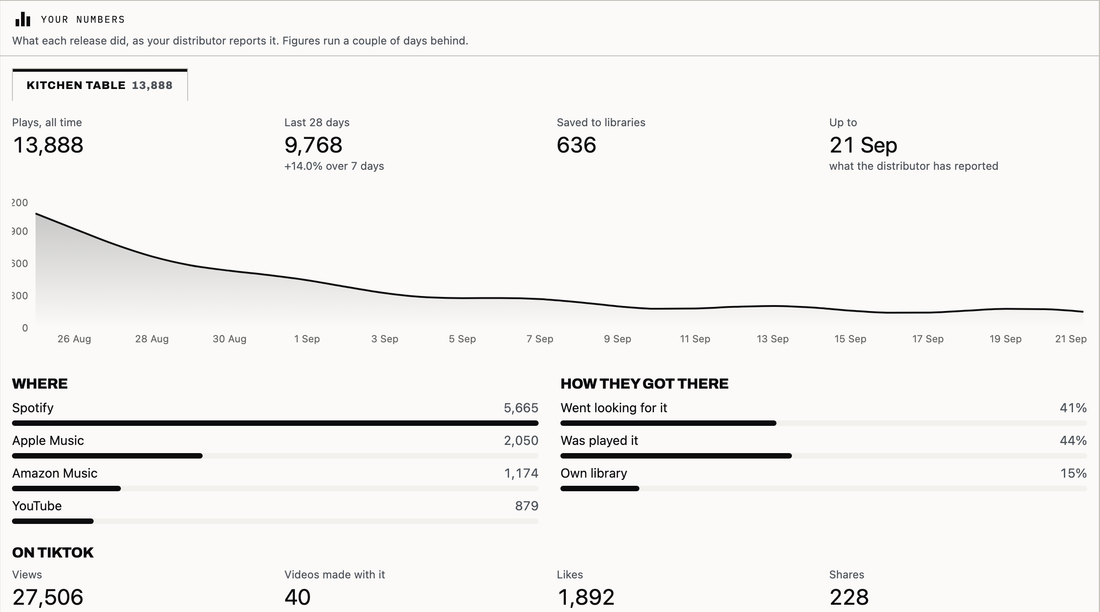
The four numbers that tell you where you stand.
- Plays all time, and the last 28 days with the direction they moved
- Saves — the number that says someone meant to come back
- The daily run, so you can see the shape: a spike that held, or one that didn't
- The date your distributor has reported up to, so you know what you are looking at
No zero ever stands in for a number nobody has sent yet. If it isn't reported, we don't show it.
Where they listened, and how they found you.
- Plays split by store — Spotify, Apple Music, Amazon, YouTube and the rest
- Went looking for it, was played it, or played it from their own library — the difference between a fan and an algorithm
- The playlists carrying the song, editorial and listener-made, with what each one brought in
- Who is listening: age and gender, where the stores report it
- What the song is doing on TikTok — views, videos made with it, likes and shares
This is the part that changes the next release: if most plays are passive, the song is being pushed; if they are active, the audience is yours. We watch what's performing — and pitch our best artists to the team at Sony.
 Listening back · 17:30
Asked before applying.
Where do the numbers come from?
From the distributor's own reporting on your releases — the same source a label reads, passed through to you. Audora is the label of record, so the reporting arrives for every release you put out with us, with nothing for you to connect.
How current are they?
Streaming reporting runs a couple of days behind everywhere, Audora included. The card tells you the date it has been reported up to, rather than implying today.
Do I need Spotify for Artists or Apple Music for Artists?
No. Those remain worth claiming — they are your profile and pitching tools — but you do not need them to see what your release did here.
Why can't I see numbers for a release that just came out?
Because nothing has been reported yet. A release shows up here once there are figures for it; an empty chart would read as "nobody listened" when it means "not counted yet".
Does every plan include this?
Yes. What a release did is your information, on every plan that can distribute.
Part of every distribution plan — see pricing, how a release goes out, and the campaign around it. We take nothing from your royalties on any plan. If you cancel and we keep your music distributed, we recover only our distribution costs from what it earns — everything above that is still paid to you.